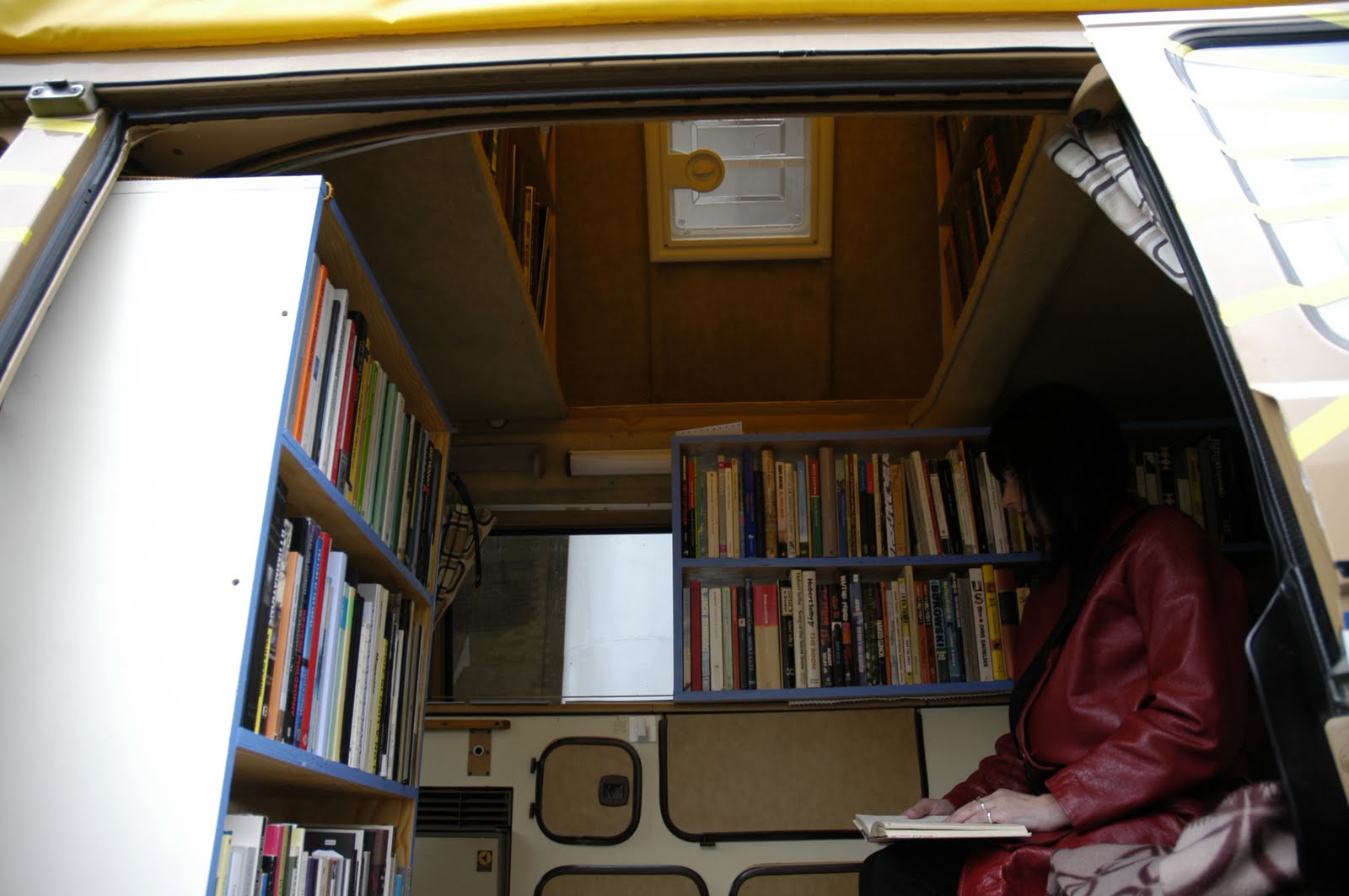
A working journal for YH485 Press' Bookmobile Project commissioned as part of Sideshow Nottingham 2010
Wednesday, 19 January 2011
A New Blog for the Project
Saturday, 11 December 2010
A Pop Wagon in the Japanese Press!
Here's an auto-translation of the section that covers The Bookmobile:
After finishing out of the building and look at book fairs, found a downright pop wagon! YH485 Press independent publisher of Bukkumobairupurojekuto. This car is the role of the mobile library, SIDESHOW is being haunted by the main exhibition hall. They intended to share information and knowledge about art, many of which are collected by SIDESHOW is provided by the participating artists.Were tightly packed with men in the vehicle floor to ceiling books is "Utopia (Utopia)," In studying, told me that participating in this project as a writer.
Monday, 6 December 2010
Reflections on Bookmobiling
Friday, 3 December 2010
Notes on the Art and Manner of Arranging Other's Books (and arranging space!)
Saturday, 27 November 2010
The Scream of Nomadic Utopianism
[I]t is a mistake to approach Utopias with positive expectations, as though they offered visions of happy worlds, spaces of fulfillment and cooperation...Indeed, the attempt to establish positive criteria of the desirable society characterizes liberal political theory from Locke to Rawls, rather than the diagnostic interventions of the Utopians, which, like those of the great revolutionaries, always aim at the alleviation and elimination of the sources of exploitation and suffering, rather than at the composition of blueprints for bourgeois comfort. The confusion arises from the formal properties of these texts, which also seem to offer blueprints: these are however maps and plans to be read negatively, as what is to be accomplished after the demolitions and the removals, and in the absence of all those lesser evils the liberals believed to be inherent in human nature.
It seems a little counter-intuitive at first. Utopias are negative? Surely the whole point of a utopia is to offer a positive vision of what is to be done; to provide a riposte to those who say "you're always moaning, but how would your world look?"? In a sense, that was my motivation in writing a utopia ('The Island') for this project: I think that this country is being governed in an increasingly hierarchical manner- but I don't think that the Labour Party or the institutional left has any real answers. Rather than just moan about this state of affairs I want to try and create a space (albeit a fictional one) that might have some suggestions; might distribute political power in a nonhierarchical manner. But in hoping that people approach my utopia with positivity- in asking them to believe in it- am I falling into a liberal trap?
I'd like to think I'm not, but I also think I know the point that Jameson is trying to make.
I certainly don't want to offer The Island as the be all and end all of political development: it may well be a place of co-operation, happiness and fulfillment, but it will also be a space of upheaval, sorrow, pain and suffering*. I don't want it to be read as a 'blueprint' that can be followed to bring about 'the good life'. It is a space of suggestions, not a space of answers. Suggestions will always bring forth new questions. They will not be adequate forever.
* * * *
I believe in what I call 'nomadic utopianism', which rejects transcendent schema in favour of prefigurative, immanent modes of becoming and which believes that a utopia is a society constantly being remade by those who inhabit it, rather than a static state of perfection. The nomadic utopia is not based on eternal principles ('justice', 'fairness', etc); but on fleeing from a hierarchical present. It draws its power from what Gilles Deleuze and Felix Guattari would call 'lines-of flight'.
Nomadic utopianism, then, is negative. It is a fleeing from hierarchy, not a move to a pre-determined utopia (such a philosophy I call State Utopianism, but that is for another time). It is in fleeing that nomadic utopianism creates something positive; shapes its utopia. This utopia may, however, see the return of hierarchy, and so the negative utopianism must never be allowed to dissipate into positive celebrations.
However noble our aims, whenever we put the flag in the ground and say 'here we are, this is the site of victory- this is our utopia' (as [neo]liberals have done) we betray that utopia and condemn it to hierarchy and dystopia.
Ursula Le Guin's The Dispossessed details this powerfully, I think, and I am also fond of Tom Moylan's message to those living in a the 'utopian' society of Whileaway in the Joanna Russ story of the same name. He tells them to
be historically vigilant...do not lock in the utopian achievement, do not remove the social utopia from the processes of time. Don’t cut a deal with the false utopian devil of your own collective imagination as it dreams of the end of history; and don’t cover up the deal by changing the colony from that of a place-in-process to one of eternal delight, literally allowing time to while away…[do] not…let the process of learning and change end, [do] not…risk a situation- brought about by either internal or external forces- that might “take away the meaning” of life.
* * * *
This is all a little confusing, though. A negativity that creates something positive? That doesn't seem to make much sense. It is perfectly possible to do clever things with the meaning of words and reference Adorno's negative dialectics here- but I think a more useful concept comes from the work of John Holloway. Inspired by the Zapatistas (whose claim that 'we make the road by walking' is a fine example of nomadic utopianism), he writes of social change coming from calls 'the scream'.
The scream, he notes, begins as a scream of negativity, of dissonance, of intensely felt pain at the horrors of the current order. It is a response that is felt physically and emotionally as much (and perhaps more than) it is thought. It is the scream that traces lines of flight, the scream that is utopianism. And just as Bakunin wrote that 'the urge to destroy is also a creative urge', this scream resonates as it is articulated begins to create a utopia. As Holloway writes, the scream is 'a refusal to be contained, an overflowing, a going beyond the pale, beyond the bounds of polite society'.
* * * *
Utopia must keep screaming. It must always fill itself to the brim with a utopianism that seeks to go further. It must always go beyond. I hope that I can capture some of this urgency in 'The Island', and by opening it to the public to engage in, I hope the text will remain open and evolving forever (more of this soon): always failing, always screaming, always trying to go beyond...
*I don't want to fall into the trap of saying 'because these are what make us human', but I think that they are sometimes inevitable consequences of freedom (a lesson that all the great dystopias teach us. And the story of man's fall from Paradise, for that matter).
Monday, 22 November 2010
There's a crack in everything: that's where the light gets in...
Friday, 19 November 2010
On the necessity of failure
fantasy is true, of course. It isn’t factual, but it is true. Children know that. Adults know it too, and that is precisely why many of them are afraid of fantasy. They know that its truth challenges, even threatens, all that is false, all that is phony, unnecessary, and trivial in the life they have let themselves be forced into living. They are afraid of dragons, because they are afraid of freedom.
All those daring birds that soar far and ever farther into space will somewhere or other be certain to find themselves unable to continue their flight and they will perch on a mast or some narrow ledge- and will be grateful even for this miserable accommodation! Yet who could conclude from this that there was not an endless free space stretching far in front of them and that they had flown as far as they possibly could? In the end however all our great teachers and predecessors have come to a standstill and it is by no means in the noblest or the most graceful attitude that their weariness has brought them to a pause: the same thing will happen to you and me! Yet what does this matter to either of us? Other birds will fly farther!
Wednesday, 10 November 2010
Thursday, 4 November 2010
Heterotopics: Getting the Public Involved

Tuesday, 2 November 2010
Bookmobile at Nottingham Contemporary 02/11/2010
Monday, 1 November 2010
Friday, 29 October 2010
Bookmobile at Nottingham Castle 29/10/10
Monday, 25 October 2010
Beginnings...
I have, for two years, studied utopianism.
I have read countless works of utopian literature; countless books of utopian theory. I see utopias in music, in maths, in film, in TV; in the tightly packed houses on commuter estates; and in the past, present and future of Nottingham- the city I call home. I consider my practices as an improvising musician and a critical educator to be utopian. I consider the detailed plans my 6 year old self drew up for a monorail system in my home village of Codsall, South Staffordshire to be utopian. I consider myself to be a utopian.
Yet I have never written a utopia.
* * * *
It is a cold, wet Saturday in October 2010. I am sat in a 1985 VW Camper van outside One Thoresby Street in the Sneinton area of Nottingham. As home to a number of artists' collectives, One Thoresby Street is one of the venues for Sideshow, the 'fringe' festival for the British Art Show 7. So too is the camper van. It belongs to the YH485 Press, and has been converted into a travelling library- the Bookmobile- for the duration of Sideshow. It will travel around the various venues, offering books, company and food. Each Saturday, in the car park of One Thoresby Street, it will also offer me. I am its writer in residence, charged with producing an original piece of writing across six Saturdays.
Soon, I'll have written a utopia.
* * * *
When you enter One Thoresby Street and climb the stairs on the east side, you get a fabulous view of 'The Island' at 'Eastside': a wasteland once occupied by railway warehouses and once full of 'development potential'. In the six years I have been in Nottingham it has been the subject of a number of regeneration bids. Luxury flats. Office spaces. 'A mixed use city quarter'. 'Due for completion in 2008'. They come, they go; no-one buys the t-shirt.
The Island is an intriguing space. It's full of spectres, and I'm fascinated by spectres. The ghosts from the past are there for all to see in the hulking shell of T.C. Hine's Great Northern Railway warehouse. Here, Nottingham was an important industrial power with innovative architecture. Not so much now, and The Island is also haunted by the spectres of a capitalist utopia that's never arrived- those regeneration bids whose fancy, CGI'd blueprints sporadically adorn the pages of the Evening Post and remain just a google search away from you now. If you know where to look you can see physical traces of this alternative present too: the high quality of tarmac on the roads that traverse The Island, ready for the wheels of a prospective investor's Lexus, and a tatty For Sale sign which adorns an anonymous industrial building on a road approaching the space. 'Gateway to Eastside', it proclaims, baring the name of a local property entrepreneur (and one time 'Secret Millionaire' on Channel Four) who was declared bankrupt in September 2009 with debts of £30million (his demise also spelled the end for Ilkeston Town Football Club, whose Chairman he became in May 2008, prompting the Ilkeston Advertiser to claim that there would be an 'exciting future' for the club).
But what I'm concerned with here is the ghost that's yet to come. What future haunts us when we look at this site? What kind of city do we want Nottingham to be?
To that, I must answer 'a utopian one'.
* * * *
It is, then, my intention to use my time as Bookmobile's writer in residence to create a utopia for 'The Island': colouring in its spaces with a vision of 'the good life'. True to my political convictions, this will be non-hierarchical, open to difference-in-itself, and in constant recognition of the need for further change. It will not be a blueprinted utopia claiming perfection forever, but what I call a 'nomadic utopia': remaining utopian only to the extent that it remains open to the future.
Perhaps this is not a true utopia; it is a 'so called utopia' of the kind detailed in Albert Meister's novel the so-called utopia of the centre beaubourg, a book I encourage you all to read (although it is hard to find and I do not have a copy myself. Maybe my housemate will be kind enough to lend his copy to Bookmobile); though it will certainly fulfill the utopian criteria of being a flight of fancy (impossible fancy, some might say), as necessity dictates I will gloss over some of the more tedious and difficult issues that would be presented were anyone to attempt to enact my vision. And it is certainly not to be read as a once-and-for-all pronoucement on how life should be lived: I would be rather worried if people thought that I'd come up with all the answers. It may, however, serve to remind people that our way of living isn't the only way of living, and that the futures of 'development potential realisation' and 'mixed use city quarters' aren't the only futures open to us.
David Bell- Bookmobile Writer in Residence
Tuesday, 5 October 2010
The Bookmobile Project: By Way of an Introduction
YH485 is a publishing and curatorial initiative based between Nottingham, Great Yarmouth (Norfolk) and London founded by Aaron Juneau, Jonathan P. Watts and Harriet Mitchell respectively. The imperatives of the organisation centre on facilitating interdisciplinary and discursive publishing and curatorial projects that take as their impetus the inclusion and engagement of an audience whose exposure to contemporary art practices and activities is limited. Further to this YH485 endeavours to aid the deconstruction of existing boundaries between rural and metropolitan practices as well as those between contemporary art practices and other, non art related, cultural disciplines.
On Bibliobuses
Bookmobiles or bibliobuses are large vehicles fitted with shelves and display units designed to house small libraries of books. These libraries travel to certain designated locales, known to their relevant communities, park up, and, once stationary, open their doors to offer a service in much the same way as a local static library. The obvious advantage of the mobile library is, as the name suggests, is that it is peripatetic. As such, it provides a more easily accessible pedagogical resource for those who may otherwise be unable to reach their closest conventional library, quite literally bringing knowledge and information to the doorstep.
This idea is not without precedent in the contemporary art world. One example that might be seen as an influence is Michael Asher’s ‘Caravan Project’ of the 1977, 1987, 1997 and 2007 Muenster Sculpture Projects. Another, more directly associated, example is the work ‘Bibliobus’ by Christian Phillip Mueller. ‘Bibliobus’ used an out of service municipal bus, which was placed in the parking lots of six schools in Biel, Switzerland for three-week periods. The bus displayed each respective schools art publications and provided facilities with which to make copies of these publications that could be taken away.
On the Project
As part of Sideshow 2010 in Nottingham YH485 has been commissioned to convert a 1985 Volkswagen Campervan into Sideshow’s very own bibliobus and transitory reading room using this often overlooked model for mobilizing and sharing knowledge and discussion to make evident the research interests of the regions artist community. Each recipient of a Sideshow commission (group or individual) has been asked to offer one or two books to the resource that has influenced their individual practices or, more specifically, their Sideshow project.
The intention is that the Bookmobile acts as a perambulatory point of cultural exchange that houses literary material and information of particular relevance to its shifting location. The library will be situated outside, or near to, many of the galleries or exhibition spaces that are involved in sideshow and the British Art Show for a specific duration. These venues include Tether, The New Art Exchange, The Art Organisation, Nottingham Trent University, Nottingham Contemporary and The Castle.
YH485 is delighted to introduce David Bell who will act as the Bookmobile’s ‘writer in residence’ for the duration of Sideshow and carry out research into the utopian pedagogical influences of the Bookmobile and consider a ‘future history’ of a utopian Nottingham. Here you will find David’s posts as the project develops along with regular updates as to the bookmobiles whereabouts and activity. We hope you enjoy following the bus!
Aaron Juneau – Co-director YH485
SIDESHOW ARTISTS BOOK FAIR
An afternoon of multiples, zines and bespoke artists’ publications for sale in the Sideshow Alley CafĂ©. This independent fair will stock affordable, handmade artists’ books, comics and zines alongside catalogues, rare volumes and limited editions.
Stalls include Staple Magazine, Bookworks, Via Vaudeville! Joff & Ollie, John Newling, Hinterland & The Reading Room, Tether, Nottingham Visual Arts, LeftLion, Georgina Barney, Backlit, Emma Cocker, Marit Muenzberg (Lemon Melon), David Berridge (verysmallkitchen), Rachel Lois Clapham (Open Dialogues), YH485 Press, Sovay Berriman, g39, and many more.
The bookfair will be followed by a talk from artist and writer, Emma Cocker at 6pm with YH485 Press