Thursday, 4 November 2010

Heterotopics: Getting the Public Involved

In my previous post I introduced the project I'll be undertaking as the Bookmobile's writer-in-residence. To briefly recap, I'll be writing an imagined folk history for a utopian community that emerges on the 'Eastside' development site (also known as 'The Island') between Sneinton and London Road in Nottingham, imaging the day-to-day occurrences in this 'anarchist' autonomous zone.


Or at least that was the plan. And it still is, but it's no longer the whole plan. For whilst working in the Bookmobile on Saturday I had an idea I'm really quite excited about.

The seeds had actually been sown earlier in the day when I read the chapter on Nottingham in Owen Hatherley's* A Guide to the New Ruins of Great Britain, a book which ruthlessly dismantles New Labour's architectural legacy. In light of my criticisms of the neoliberal development plans put forward for the tract of land I'll be writing about, the subtitle of this chapter- 'The Banality of Aspiration' seemed strangely appropriate. I also thought of Hatherley's observations of a similarly derelict piece of wasteland in Bradford (itself the subject of hopeless redevelopment plans). Here,


My utopia, I thought, was an attempt to imagine a different kind of weed that might grow in the crack.


My train of thought then naturally progressed on to consider what Owen himself might make of my plans. He's a writer and thinker I admire greatly, and I'm thrilled by his criticisms of Blairism's architectural legacy (which, of course, can be used as a metaphor for the whole New Labour project). I don't, however, fully agree with his solution. Whilst I'm a huge fan of the aesthetics of the brutalist architecture he adores, I'm too much of an anarchist to fully get behind his paternal, state-centric socialism. I didn't imagine my utopian plans for Eastside containing any brutalist blocks, or even any of the smaller scale resident-controlled cul-de-sacs he has also advocated.

But do my misapprehensions mean they shouldn't be allowed on my utopia? Why not? These misapprehensions could just as easily be misconceptions, after all. And besides, I like to look at such architecture, and many people like to live in them. Not everyone wants to be in one of the self-built houses that I'd envisaged springing up (of the kind eulogised by Colin Ward, Dennis Hardy and John Turner), and that I myself am so fond of (like many things in my life, this can perhaps be traced back to the Titfield Thunderbolt, but that's perhaps for another time...).


At this moment I realised I was quite scared. I didn't want the responsibility of writing this utopia on my own. I am, after all, totally against the hierarchical, blueprinted nature of the traditional utopian text (or the common reception of the traditional utopian text, at least) in which the author plays God. I've previously mentioned Albert Meister's the so-called utopia of the centre beaubourg as offering a possible solution to this problem, but even this is troubling: what can't live in the imagination of the author can't live in that author's utopia. And I'm not sure my imagination is up to the task.

My decision, then, was to invite people to co-produce this utopia with me. Initially, I thought I would invite specific people to contribute and help develop the utopia. I hastily began typing a list of who I wanted to contribute. Owen was on there, as were a number of other people whose work inspires me. In no time at all, I had twenty-five names: feminists, music theorists, anarchists, artists, popular educators, Marxists: implicit or explicit utopians all, and all people I'd want with me in a utopian community.

This still wasn't enough though. These people were hand-picked by me. I don't agree with all of them, but they are people whose politics I generally feel safe with. There was no-one there who was going to push my utopia into troublesome areas. It was too safe, too cozy. My concept of 'nomadic utopianism' does not allow for such things: that way authoritarianism and perfection creep in round the back door, and hierarchies emerge to suck the life from your utopia. I want to create what Foucault might call a 'heterotopia'; I want to test the limits of disensus.

I made the decision, then, that this utopia is to be constructed by the public. I will still invite certain people to contribute, but there will be an open invite too. These contributions won't have to be textual: people could, if they wanted, produce artifacts from the utopia (pieces of jewelry, paintings, music....).

This presents certain logistical problems which I'm working on with YH485, but I'm optimistic they can be overcome. The current plan is for me to write the text as originally planned and then invite interventions. I guess this still makes it more 'my' utopia than anyone else's, but hopefully 'The Island' will be pulled far from where I imagined it might go. And of course if you come and see me in the Bookmobile while I'm writing, you might be able to get your contribution in earlier.

*Co-incidentally, Owen's got an essay on Warsaw in YH485's new paper, Inside.


Tuesday, 2 November 2010

Bookmobile at Nottingham Contemporary 02/11/2010


The Bookmobiles decal designs were created by artist Bruce Asbestos for YH485. Please see http://www.bruceasbestos.info/

Monday, 25 October 2010

Beginnings...

I have, for two years, studied utopianism.


I have read countless works of utopian literature; countless books of utopian theory. I see utopias in music, in maths, in film, in TV; in the tightly packed houses on commuter estates; and in the past, present and future of Nottingham- the city I call home. I consider my practices as an improvising musician and a critical educator to be utopian. I consider the detailed plans my 6 year old self drew up for a monorail system in my home village of Codsall, South Staffordshire to be utopian. I consider myself to be a utopian.


Yet I have never written a utopia.


* * * *


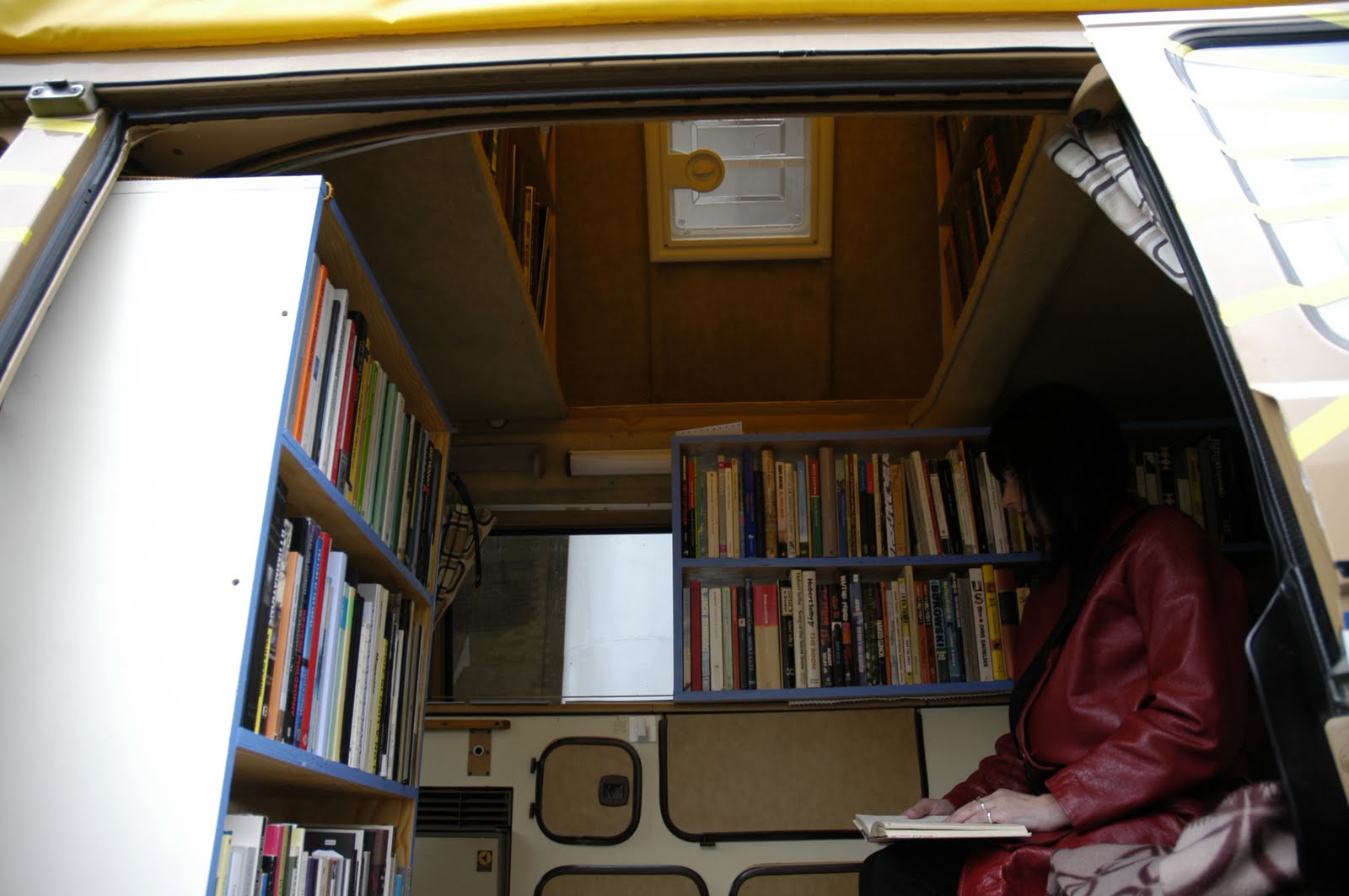
It is a cold, wet Saturday in October 2010. I am sat in a 1985 VW Camper van outside One Thoresby Street in the Sneinton area of Nottingham. As home to a number of artists' collectives, One Thoresby Street is one of the venues for Sideshow, the 'fringe' festival for the British Art Show 7. So too is the camper van. It belongs to the YH485 Press, and has been converted into a travelling library- the Bookmobile- for the duration of Sideshow. It will travel around the various venues, offering books, company and food. Each Saturday, in the car park of One Thoresby Street, it will also offer me. I am its writer in residence, charged with producing an original piece of writing across six Saturdays.


Soon, I'll have written a utopia.


* * * *


When you enter One Thoresby Street and climb the stairs on the east side, you get a fabulous view of 'The Island' at 'Eastside': a wasteland once occupied by railway warehouses and once full of 'development potential'. In the six years I have been in Nottingham it has been the subject of a number of regeneration bids. Luxury flats. Office spaces. 'A mixed use city quarter'. 'Due for completion in 2008'. They come, they go; no-one buys the t-shirt.


The Island is an intriguing space. It's full of spectres, and I'm fascinated by spectres. The ghosts from the past are there for all to see in the hulking shell of T.C. Hine's Great Northern Railway warehouse. Here, Nottingham was an important industrial power with innovative architecture. Not so much now, and The Island is also haunted by the spectres of a capitalist utopia that's never arrived- those regeneration bids whose fancy, CGI'd blueprints sporadically adorn the pages of the Evening Post and remain just a google search away from you now. If you know where to look you can see physical traces of this alternative present too: the high quality of tarmac on the roads that traverse The Island, ready for the wheels of a prospective investor's Lexus, and a tatty For Sale sign which adorns an anonymous industrial building on a road approaching the space. 'Gateway to Eastside', it proclaims, baring the name of a local property entrepreneur (and one time 'Secret Millionaire' on Channel Four) who was declared bankrupt in September 2009 with debts of £30million (his demise also spelled the end for Ilkeston Town Football Club, whose Chairman he became in May 2008, prompting the Ilkeston Advertiser to claim that there would be an 'exciting future' for the club).


But what I'm concerned with here is the ghost that's yet to come. What future haunts us when we look at this site? What kind of city do we want Nottingham to be?


To that, I must answer 'a utopian one'.


* * * *


It is, then, my intention to use my time as Bookmobile's writer in residence to create a utopia for 'The Island': colouring in its spaces with a vision of 'the good life'. True to my political convictions, this will be non-hierarchical, open to difference-in-itself, and in constant recognition of the need for further change. It will not be a blueprinted utopia claiming perfection forever, but what I call a 'nomadic utopia': remaining utopian only to the extent that it remains open to the future.


Perhaps this is not a true utopia; it is a 'so called utopia' of the kind detailed in Albert Meister's novel the so-called utopia of the centre beaubourg, a book I encourage you all to read (although it is hard to find and I do not have a copy myself. Maybe my housemate will be kind enough to lend his copy to Bookmobile); though it will certainly fulfill the utopian criteria of being a flight of fancy (impossible fancy, some might say), as necessity dictates I will gloss over some of the more tedious and difficult issues that would be presented were anyone to attempt to enact my vision. And it is certainly not to be read as a once-and-for-all pronoucement on how life should be lived: I would be rather worried if people thought that I'd come up with all the answers. It may, however, serve to remind people that our way of living isn't the only way of living, and that the futures of 'development potential realisation' and 'mixed use city quarters' aren't the only futures open to us.


David Bell- Bookmobile Writer in Residence

Tuesday, 5 October 2010

The Bookmobile Project: By Way of an Introduction

On YH485

YH485 is a publishing and curatorial initiative based between Nottingham, Great Yarmouth (Norfolk) and London founded by Aaron Juneau, Jonathan P. Watts and Harriet Mitchell respectively. The imperatives of the organisation centre on facilitating interdisciplinary and discursive publishing and curatorial projects that take as their impetus the inclusion and engagement of an audience whose exposure to contemporary art practices and activities is limited. Further to this YH485 endeavours to aid the deconstruction of existing boundaries between rural and metropolitan practices as well as those between contemporary art practices and other, non art related, cultural disciplines.

On Bibliobuses

Bookmobiles or bibliobuses are large vehicles fitted with shelves and display units designed to house small libraries of books. These libraries travel to certain designated locales, known to their relevant communities, park up, and, once stationary, open their doors to offer a service in much the same way as a local static library. The obvious advantage of the mobile library is, as the name suggests, is that it is peripatetic. As such, it provides a more easily accessible pedagogical resource for those who may otherwise be unable to reach their closest conventional library, quite literally bringing knowledge and information to the doorstep.

This idea is not without precedent in the contemporary art world. One example that might be seen as an influence is Michael Asher’s ‘Caravan Project’ of the 1977, 1987, 1997 and 2007 Muenster Sculpture Projects. Another, more directly associated, example is the work ‘Bibliobus’ by Christian Phillip Mueller. ‘Bibliobus’ used an out of service municipal bus, which was placed in the parking lots of six schools in Biel, Switzerland for three-week periods. The bus displayed each respective schools art publications and provided facilities with which to make copies of these publications that could be taken away.

On the Project

As part of Sideshow 2010 in Nottingham YH485 has been commissioned to convert a 1985 Volkswagen Campervan into Sideshow’s very own bibliobus and transitory reading room using this often overlooked model for mobilizing and sharing knowledge and discussion to make evident the research interests of the regions artist community. Each recipient of a Sideshow commission (group or individual) has been asked to offer one or two books to the resource that has influenced their individual practices or, more specifically, their Sideshow project.

The intention is that the Bookmobile acts as a perambulatory point of cultural exchange that houses literary material and information of particular relevance to its shifting location. The library will be situated outside, or near to, many of the galleries or exhibition spaces that are involved in sideshow and the British Art Show for a specific duration. These venues include Tether, The New Art Exchange, The Art Organisation, Nottingham Trent University, Nottingham Contemporary and The Castle.

YH485 is delighted to introduce David Bell who will act as the Bookmobile’s ‘writer in residence’ for the duration of Sideshow and carry out research into the utopian pedagogical influences of the Bookmobile and consider a ‘future history’ of a utopian Nottingham. Here you will find David’s posts as the project develops along with regular updates as to the bookmobiles whereabouts and activity. We hope you enjoy following the bus!

Aaron Juneau – Co-director YH485